
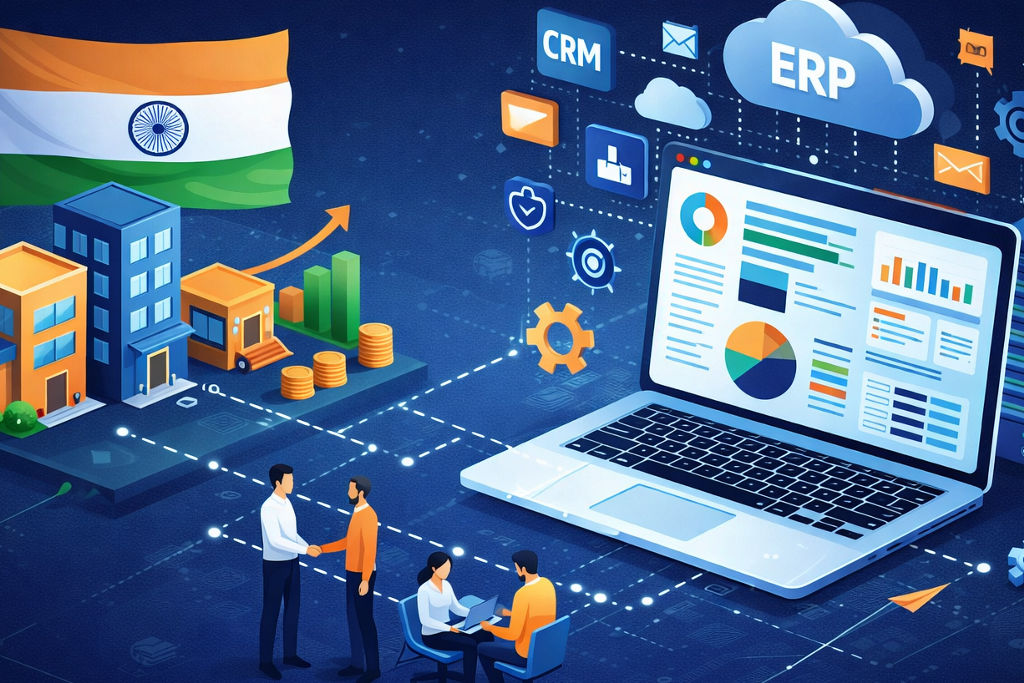
Why This Is the Most Serious and Most Decisive Moment for Focus
India’s SME sector is not merely expanding; it is maturing.
What was once an ecosystem driven by hustle, intuition, and heroic firefighting is now being compelled by markets, regulators, customers, and capital to operate with discipline, traceability, and foresight.
At the centre of this transition sits the B2B ERP and business software industry.
Not as a vendor class.
Not as a cost centre.
But as a structural enabler of survival and scale.
This article is written for those who sell, build, implement, or decide upon ERP and enterprise software for SMEs and for founders who sense that “something must change,” even if they cannot yet articulate what.
The Indian SME Reality – Honest, Unpolished, True
Indian SMEs are unlike their Western counterparts.
They are:
- Owner-driven, not management-driven
- Relationship-led, not process-led
- Cash-sensitive, not valuation-obsessed
- Operationally resilient, but systemically fragile
For decades, these businesses grew despite the absence of systems.
Today, they will only grow because of systems.
Why?
Because the external environment has changed irreversibly.
Why Now Is the Right Time Not Next Year, Not “After This Quarter”
1. Compliance Has Moved from Event-Based to Continuous
GST, e-Invoicing, E-Way Bills, TDS/TCS, labour compliances, import–export documentation none of these are new.
What is new is velocity.
Regulatory scrutiny is now: –
- Real-time
- API-driven
- Non-negotiable
Manual accounting, fragmented data, and post-facto reconciliation are no longer operational inconveniences; they are business risks.
ERP has shifted from record-keeping to regulatory insurance.
2. Customers Now Audit Before They Trust
Large buyers, exporters, MNCs, and even organized domestic players no longer ask only for price.
They ask:
- Can you trace a batch?
- Can you commit to delivery accuracy?
- Can you show historical consistency?
- Can you scale without chaos?
An SME without structured systems is silently filtered out often without explanation.
ERP is now a qualification criterion, not a productivity tool.
3. Founders Are Exhausted And They Know It
Behind closed doors, many SME owners admit:
- They work too much
- They decide too much
- They firefight too often
ERP, when positioned honestly, is not about dashboards.
It is about reducing dependency on one human brain.
That is not automation.
That is liberation.
The ERP Business in SMEs: – What It Really Is (And What It Is Not)
It Is NOT:
- A software sale
- A feature comparison
- A one-time implementation
- A “best practices” lecture
It IS:
- A business transformation partnership
- A long-cycle trust transaction
- A change-management exercise disguised as software
- A mirror that forces owners to confront inefficiencies
This is why ERP sales in SMEs fail not because software is weak, but because truth is uncomfortable.
The Real Challenges Practical, Uncomfortable, Relatable
Challenge 1: “We Are Unique. ERP Will Not Fit Us.”
Reality:
Most SMEs are unique in their exceptions, not in their fundamentals.
Procurement, production, inventory, sales, finance these are universal.
What differs is discipline, not structure.
Solution:
Design SOPs before configuration.
ERP must follow process clarity, not impose borrowed templates.
Challenge 2: Owner-Led Resistance, Disguised as Pragmatism
“I have run this business for 25 years without ERP.”
True.
But the market you operated in for 25 years no longer exists.
Solution:
ERP conversations must be framed in risk mitigation and control, not efficiency jargon.
Owners do not buy speed. They buy certainty.
Challenge 3: Implementation Fear from Past Trauma
Many SMEs have already been burned by:
- Over-promised demos
- Under-skilled consultants
- Vanishing support teams
Solution:
The future of ERP in SMEs lies in:
- Phased implementation
- Milestone-based commercial models
- Measurable stabilization periods
ERP must earn trust incrementally.
Challenge 4: Cost Sensitivity vs Long-Term Value
SMEs negotiate hard—not because they undervalue technology, but because cash discipline is survival instinct.
Solution:
Shift conversations from “license cost” to:
- Working capital visibility
- Inventory leakage reduction
- Compliance risk avoidance
- Decision latency reduction
ERP ROI in SMEs is defensive before it is offensive.
Why Focus Matters Now — For ERP Companies and Partners
The Indian SME ERP market is not exploding because of hype.
It is expanding because of inevitability.
But only for those who remain focused.
This is not a volume game.
This is a credibility game.
Winners in this space will: –
- Choose industries deliberately
- Develop domain depth, not generic pitch decks
- Invest in people who understand factories, not just frameworks
- Speak the language of owners, not consultants
ERP businesses that chase every segment will dilute trust.
Those who commit to specific SME ecosystems will compound relevance.
The Future: Quiet, Structured, Unavoidable
The next decade of Indian SME growth will not be dramatic.
It will be methodical.
ERP will not be celebrated.
It will be assumed.
Businesses without systems will not collapse overnight.
They will simply be left behind, slowly, invisibly, irreversibly.
For ERP builders, sellers, and implementers, this is not a golden rush.
It is something rarer.
A chance to build foundational infrastructure for the backbone of the Indian economy.
Those who remain focused now will not just sell software.
They will shape how Indian SMEs think, decide, comply, and scale.
And that is a responsibility far greater than a transaction.
If this perspective resonates with your experience in the SME ecosystem whether as a founder, CFO, operations head, or ERP professional it may be worth having a deeper conversation. Not about software. But about readiness.
If you sense your organisation is approaching that inflection point, I welcome a conversation not a pitch or a demo, but a practical discussion on process maturity, control, and scalability.
You may call me directly on 7984617782 or write to hello@neerajchoudhary.com.