
You go anywhere today boardrooms, startup hubs, factory floors, cafés outside co-working spaces and talk to professionals, business owners, founders, or directors. One theme dominates every conversation: Artificial Intelligence.
A strange duality has emerged.
On one side, frontline professionals’ coders, developers, designers, legal graduates, analysts are living under constant pressure. There is a growing fear that once their organization “adopts AI,” their roles will become redundant. Job insecurity today is no longer driven by market slowdown; it is driven by technological speculation.
On the other side, founders of startups and MSMEs often view AI with almost celebratory optimism. Reduced manpower cost. Faster execution. Higher margins. The belief that AI will magically unlock scale, profitability, and efficiency almost overnight.
This contrast forces an uncomfortable but necessary question:
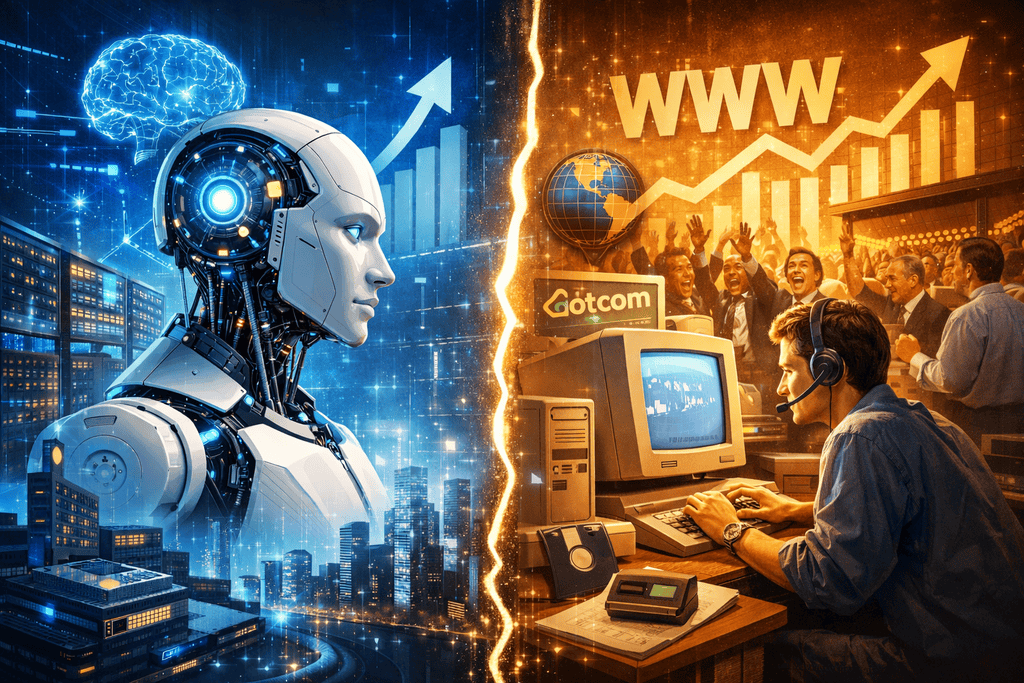
Is AI truly a menace to human work or are we witnessing another dot-com style bubble?
The Dot-Com Parallel Hype Before Maturity
To answer this, we must revisit history.
The dot-com boom of the late 1990s was not merely a technological revolution; it was a speculation-driven euphoria. Anything with a “.com” valuation received funding, media attention, and blind faith. Business fundamentals were secondary. Process maturity was optional. Ethics and governance were often absent.
Then reality arrived.
It took nearly 20–25 years for internet technology to truly settle into the economic fabric. When the bubble burst, the noise collapsed. What survived were not the loudest startups, but organizations built on:
- Strong processes
- Ethical practices
- Sustainable unit economics
- Long-term thinking
Ironically, those survivors used the internet the very technology that caused the bubble as a ladder for growth.
The bubble burst, but the technology stayed.
A.I. Today – Capability vs Expectation Gap
AI today feels eerily similar.
There is genuine innovation no doubt about it. Machine learning, large language models, computer vision, predictive analytics these are powerful tools. But somewhere between capability and expectation, a dangerous gap has formed.
AI is being projected as: –
- A replacement for human judgment
- A substitute for experience
- A shortcut to business excellence
In reality, AI is none of these.
AI is amplification, not intelligence.
AI is acceleration, not direction.
AI is executional leverage, not strategic wisdom.
Much like the internet in the 90s, AI is being oversold before it is fully understood.
The ERP, Software & Enterprise Reality
The most interesting signals are emerging from enterprise technology ERP, business software, and operational systems.
These systems are often misunderstood as “IT businesses.” They are not.
They are process magnifiers.
An ERP does not fix a broken procurement process.
BI does not compensate for poor data discipline.
RPA does not eliminate inefficiency it automates it.
Yet for the past few years, the enterprise ecosystem has been flooded with jargon:
- AI-powered ERP
- RPA-first transformation
- Autonomous decision-making
- Predictive everything
Recently, however, a subtle but important shift has begun.
Experts are pushing back.
Not against AI itself but against the hungama around it. The conversation is moving from “What AI can do” to “What AI should not be expected to do.”
Reality is resurfacing.
Human Brilliance Is Not Obsolete
A symbolic moment in this debate came when Magnus Carlsen defeated ChatGPT in a chess match without losing a single move.
This was not about chess.
It was about context, intuition, and creative reasoning.
For a brief period, humanity began underestimating itself. We started believing intelligence could be fully replicated, wisdom could be automated, and judgment could be commoditized.
But machines even the most advanced ones do not:
- Understand intent
- Carry lived experience
- Bear ethical responsibility
- Navigate ambiguity instinctively
And most importantly, every machine, every algorithm, every model is designed by humans.
AI is a reflection of human intelligence not its replacement.
What Will Likely Happen Next
If history is any guide, the AI curve will follow a familiar pattern:
- Peak Hype – inflated expectations, fear, overfunding
- Reality Correction – limitations exposed, costs surface
- Bubble Deflation – weak business models collapse
- Quiet Integration – AI becomes invisible but essential
- Sustainable Value Creation – process-led, ethical, human-centric organizations thrive
Just like the dot-com era.
The gas will come out.
The noise will reduce.
And what will remain is real business, powered by AI not dominated by it.
I strongly feel
AI is not a menace.
AI is not a miracle.
AI is not the end of human relevance.
It is a tool powerful, transformative, but incomplete without human judgment.
The organizations that will win are not those that replace people with AI, but those that combine human brilliance with machine precision.
Exactly how it happened with the internet.
Exactly how it will happen again.
History doesn’t repeat but in technology, it often rhymes.