

In many organisations, sales remain the most visible department and yet, paradoxically, one of the most misunderstood. It is spoken about casually, evaluated harshly, and often taken far too lightly by functions that do not directly face the market every single day.
Sales professionals, despite being the commercial front line of the enterprise, are frequently treated as organisational outsiders valued for outcomes but questioned for intent; expected to deliver but rarely trusted in proces
HR assumes sales creates hype and can “sell sand as gold powder.”
Accounts believes sales spends too freely and demands exceptions that “others cannot afford.”
The project and development teams remark sarcastically, “What a great job travelling and enjoying life.”
And the management, while expecting miracles, is often interested in only one language: results.
The result is an unfortunate workplace reality:
Sales is frequently treated as a “third-world function” within the very organisation it powers expected to win battles, but denied the infrastructure, authority, and respect required to win wars.
The Most Dangerous Scenario: When Management Does Not Trust Sales
The situation becomes even more interesting more damaging, more chaotic in those organisations where the management itself does not truly trust its own sales team.
In such environments-
- Sales leaders are not given autonomy to build and run the function with accountability.
- Sales becomes heavily controlled, second-guessed, and micromanaged often by individuals who do not operate in the market daily.
- Hiring is treated as an administrative activity rather than a strategic decision.
Even when salespeople are hired, sales leadership is often not consulted in the selection process. Candidates are recruited through assumptions, convenience, familiarity, or personal confidence rather than fitment, competence, and sales temperament.
This predictably results in:
- Wrong candidate selection
- Wrong behaviour and wrong outcomes
- Wrong accountability loops
- And, eventually, wrong conclusions “sales doesn’t work here”
Soon, the sales team member either resigns out of frustration, or is forced to resign due to “non-performance.”
And throughout this entire cycle, founders and business owners continue defending their selection often emotionally and repeatedly despite results remaining unchanged.
What follows is not a performance culture. It is commercial chaos.
The Visible Victory vs. The Invisible Work
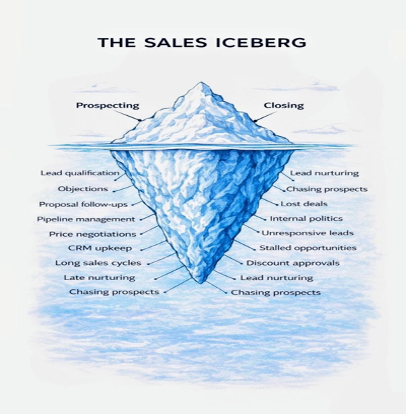
What truly drives results in sales sits far below the surface. People notice the dashboard numbers.
They notice the celebratory email.
They notice the quarterly target achieved.
But what goes unseen is the relentless work and uncertainty that precedes every win.
Behind every closed deal, sales teams routinely navigate:
- Prospects going silent after weeks sometimes months of engagement
- Follow-ups competing against overflowing inboxes and shrinking attention spans
- Objections that shift, budgets that disappear, and decision-makers who change mid-cycle
- Internal alignment on pricing, commercials, approvals, credit terms, and delivery feasibility
- Long sales cycles that punish impatience and test forecasting discipline
- Pipeline pressure alongside CRM and reporting expectations
- Lost opportunities that still demand accountability, explanations, and learning
- The emotional labour of managing rejection and uncertainty while staying motivated
And when a deal finally closes after all of that after the pursuit, the resets, the persuasion, the negotiation it is often summarised in a single line: – “Good job. Target achieved.”
Sales Is Not a department. It Is a Load-Bearing Business Function.
The hard truth is this: – Most departments can do their jobs exceptionally well in isolation and still not directly move revenue.
Sales cannot.
Sales operates in the only arena where certainty is scarce: the customer’s mind. Sales is the function that must repeatedly win trust before it wins contracts.
It must secure belief before it secures purchase orders. It must survive rejection before it earns celebration.
While other teams optimise what exists, sales must pursue what does not yet exist: – attention, trust, preference, urgency, commitment, closure.
Sales does not merely sell products. Sales sells confidence through clarity. Sales sells certainty through credibility.
Sales sells commitment through consistency.
And it does so while being judged by the most unforgiving metric of all: – outcomes that are not entirely within its control.
Sales Leadership Is the Discipline Behind the Revenue Sales leadership is not merely the ability to close deals.
It is the ability to build a team that can sustain pressure without losing judgement.
It involves:
- designing the right structure,
- hiring the right profile,
- coaching behaviours,
- building repeatable performance,
- and creating resilience across quarters not just moments. The finest sales leaders are not only closers.
They are builders of discipline, process, consistency, courage, and endurance. Recognition Is Not Courtesy. It Is Strategy.
For leadership teams, recognising the invisible labour and complexity behind sales outcomes is not optional. It is not generosity. It is not motivational theatre.
It is strategic leadership.
Because when sales is consistently reduced to targets alone and simultaneously deprived of trust, autonomy, and the right hiring decisions organisations create a predictable cycle:
- underperforming hires,
- unstable teams,
- inconsistent pipelines,
- blame without diagnosis,
- and results without sustainability.
If organisations want stable revenue, they must stop treating sales as a disposable function and start treating it as a high-skill, high-pressure capability.
Because revenue is not generated by products alone.
Revenue is generated by people under pressure making difficult things happen in uncertain markets.
And in most companies, no one carries that pressure more consistently than the sales team.
Food for Thought-
Sales is not the department that “talks.”
Sales is the department that brings the world to your doorstep and convinces it to stay.
Respecting sales is not sentiment. Trusting sales is not optional.
Empowering sales is not a luxury.
It is the foundation of commercial stability.