
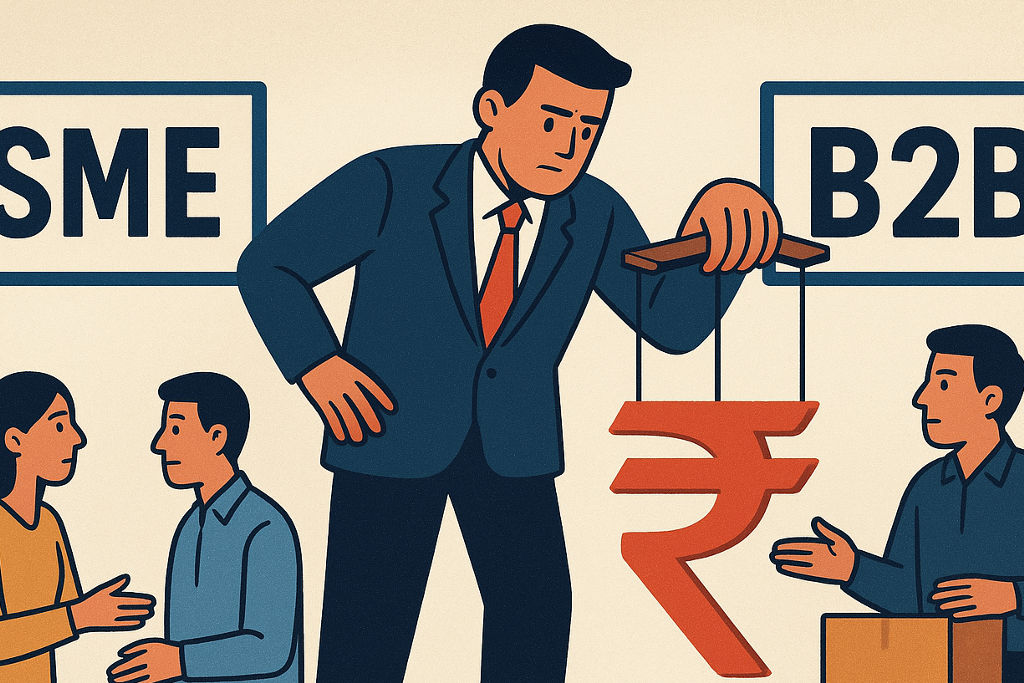
Indian SMEs are the backbone of the economy, contributing around 30% to GDP and nearly half of exports.
Yet, when it comes to B2B growth, most of them are stuck at the same place for 5–10 years
same turnover band, same type of customers, same crises repeating.
If you sit with founders long enough, you’ll see a pattern:
- They want to do sales themselves.
- They also want to do marketing, product, accounts, HR, IT, and sometimes even drafting purchase orders.
- They complain that “good people are not available” but will not trust or empower the people they do have.
- When something breaks, they don’t audit the system they sacrifice a person.
This is not laziness or stupidity. It’s a system built on:
- Scarcity thinking
- Deep fear of losing control
- A belief that “only I know my business”
And it kills B2B growth quietly.
Why Founders Want to Do Everything Themselves
1. The Origin Story Trap
Most Indian SMEs are first-generation or first-serious-growth generation.
The founder built the business like this:
- He (and it is usually a he) did the first sales.
- He handled suppliers, quality, collections, negotiations.
- He survived power cuts, delayed payments, GST shocks, demonetisation, COVID stress.
His core belief becomes:
“I survived because I controlled everything.”
Now, when the company reaches ₹30–50 crore and needs systems, not heroics, the founder is still running it with the same survival mindset.
Delegation feels like danger.
Systems feel like “too much theory”.
Specialists feel like “expense, not investment”.
So he keeps sales in his pocket.
2. Mistrust Disguised as “Involvement”
You’ll hear lines like:
- “I am very involved in everything.”
- “I don’t believe in leaving things fully on the team.”
- “Customer is my god, I cannot take chance.”
This sounds noble.
In reality, it often means: “I don’t trust anyone enough to let them own outcomes.”
So what happens?
- Salesperson prepares a quotation: founder edits it.
- Marketing suggests a campaign: founder rewrites the entire idea.
- Account team makes a policy: founder overrides it because “this client is special”.
- Even technical domain process, design, costing must carry the founder’s stamp.
The message to the team is very clear:
“You are an extra pair of hands, not a brain.”
You don’t get salespeople. You get order takers.
3. The Fear of Talent That Is Smarter
A good B2B sales head will:
- Question discount policies
- Push for better product–market fit
- Demand clarity on positioning and pricing
- Say “no” to some customers
This is uncomfortable for a founder used to yes-boss culture around him.
So many SMEs subconsciously prefer:
- A loyal, average person they can control over
- A sharp, independent person they must partner with.
Result:
They neither hire knowledgeable people nor let existing people grow into knowledge roles.
They say “team is weak” but design it that way.
Why They Don’t Let Even Their Team or Customers Breathe
This is the next layer.
1. Customers Must Follow “Our Way”
When you hear:
- “Customer should follow our process.”
- “If they want our price, they must adjust to our system.”
It sounds like discipline.
In B2B reality, it often means:
- No flexibility in commercial discussions
- No adaptation to customer’s buying process
- No empathy for the buyer’s internal politics
The founder wants the market to adjust to his mental model, not the other way around.
This works in a monopoly.
It fails in a competitive B2B environment where:
- Your competitor is ready to align to the customer’s RFQ, approval workflow, and documentation demands.
- Your customer doesn’t care about your internal drama – they care about consistency, reliability, and clarity.
2. Team Must Follow “My Guidelines Only”
Founders often say:
“I am open to ideas. They can suggest anything.”
But the script goes like this:
- Team suggests a new market segment.
- Founder says, “We tried in 2014. It did not work.”
- Discussion closed.
Or
- Salesperson wants to visit new geographies.
- Founder says, “First sell more in our existing area.”
- No budget, no strategy, only a moral lecture.
Soon, the team learns:
“Boss has already decided. We are here to execute, not to think.”
So they stop thinking.
Founder then complains:
“Nobody takes initiative. I have to do everything.”
This is not a talent problem.
This is a permission problem.
The Scapegoat Ritual
When things start cracking a big customer is lost, cash flow gets tight, or targets are missed – the pattern is predictable:
- There is no honest review of:
- Was the product right?
- Was the pricing structure logical?
- Did we equip sales with tools, content, training?
- Did we even have a real strategy?
- Instead, the hunt begins for:
- The non-performing sales guy
- The “careless” account manager
- The “irresponsible” project coordinator
- One person is picked, humiliated, sometimes fired.
Emotional message to the founder:
“Problem is solved. See, we took action.”
Actual reality:
- The system remains broken.
- The next person inherits the same mess.
- The founder’s belief “I have to control everything” becomes even stronger.
This cycle repeats for years.
The Real B2B Sales Problem in Indian SMEs
Let’s strip away the noise.
Most content on B2B talks about:
- Funnels
- CRM
- Playbooks
- ABM
- SPIN, Challenger, MEDDIC, and other frameworks
These are valuable but they assume:
- There is a leadership willing to let sales become a serious function, not a side activity.
- There is psychological safety for salespeople to share bad news, feedback, and market truth.
- The founder is okay with being proven wrong sometimes.
In Indian SMEs, especially in manufacturing and technical businesses, the core issues are:
- No defined sales role
“Sab kuch thoda-thoda” people handle sales along with operations, service, and admin. There is no dedicated Mindspace. - No owner for sales process
Who designs sales stages, follow-up frequency, qualification criteria, proposal templates, negotiation strategy? Nobody full-time. - No clarity on ideal customer
Everything is opportunity. If the customer has GST and a gate, we want them. No segmentation, no ICP, no prioritisation. - No infrastructure for sales
Proper CRM usage, content, brochures, case studies, TCO calculations, ROI calculators, demos, success stories – all are afterthoughts. - No culture of listening to the market
When sales comes back with feedback:
- “Customer wants faster delivery.” → “Tell them impossible.”
- “They are comparing us with X competitor.” → “They are useless; we are much better.”
- “They want financing flexibility.” → “We are not a bank.”
So the market keeps giving signals.
The company keeps defending itself.
And revenue flatlines.
Why This Is More Dangerous in B2B Than B2C
In B2C, you can sometimes grow with chaos if:
- Demand is exploding
- Product is viral
- Capital is available
In B2B, especially in Indian industries like manufacturing, engineering, textiles, chemicals, capital goods, software for enterprises:
- Sales cycles are long
- Relationships are deep
- Switching costs are high
- Referrals matter more than advertisements
Here, one mishandled relationship can delay growth by 2–3 years in a region or segment.
You can’t afford:
- Founder ego in every negotiation
- Untrained salespeople promising anything
- Random discounts given without strategy
- Projects accepted without capacity planning or margin checks
Yet this is exactly what happens daily.
So What Should Indian SME Founders Actually Do?
Let’s be practical. Not everyone can suddenly become “corporate MNC style”.
But some hard shifts are non-negotiable.
1. Decide: Are You the Rainmaker or the System Builder?
If you genuinely love sales – talking to customers, travelling, negotiating – then:
- Own sales 100% for a time.
- But then hire a strong No. 2 and build a team under you.
- Your job becomes: open doors, shape strategy, mentor big deals – not micromanage quotations.
If you don’t love sales, then:
- Admit it.
- Hire someone who does.
- Give them clear KPIs, authority, and 12–18 months to prove.
Half-owning sales while half-owning ten other things is the fastest way to kill growth.
2. Hire One Serious Sales Leader, Not Five Cheap Salespeople
Instead of:
- 4–5 average sales executives at low salary, all confused, all treated as juniors
Consider:
- 1 solid sales leader:
- with real B2B experience,
- capacity to design process,
- and the spine to say “no” when needed.
Pay this person well.
Tie them to outcomes.
Give them respect in front of the team.
Good people don’t leave SMEs because of money alone.
They leave because of disrespect, interference, and lack of say.
3. Let the Team Own at Least One Zone Fully
Pick one:
- A geography (e.g., South Gujarat, Maharashtra, NCR), or
- A segment (e.g., textile mills between ₹50–200 crore), or
- A product line
And say to your sales lead:
“You own this zone. Targets are mutual. Within our broad guardrails, you decide how to play.”
No back-door pricing.
No overriding their decisions in front of customers.
No sudden U-turns without discussion.
You can still monitor, review, and challenge.
But ownership must be real, not on paper.
4. Separate “Loyalty” From “Capability”
Many SMEs reward:
- The person who has been with them for 10–15 years
more than - The person who can actually build the next 10–15 years.
Loyalty is priceless – it should be rewarded.
But loyalty is not a substitute for competence.
You can:
- Keep loyal people in roles where they fit (operations, service, admin)
- And bring in specialists for sales, marketing, finance, digital, etc.
This is not betrayal.
This is survival.
5. Audit Systems, Not People
When something goes wrong:
Instead of starting with:
“Who did this?”
Start with:
“How did our system allow this to happen?”
- Did we have a clear approval matrix?
- Did we have a documented process?
- Did we train the person?
- Did we give them tools and realistic timelines?
If the answer is “no” to many of these, then the problem is management design, not employee morality.
The Mindset Shift: From “My Business” to “Our Organisation”
Most Indian SMEs are still emotionally run as:
“Yeh mera business hai.”
The next stage of B2B growth demands:
“Yeh hamara organisation hai.”
That shift looks like:
- From founder’s personal style → to documented, teachable sales system
- From blind loyalty → to loyalty + high standards
- From short-term blame → to long-term capability building
- From control → to governance
B2B sales will not transform in a company where the founder:
- Wants every credit,
- Approves every decision,
- And escapes every responsibility when things fail.
It will transform in a company where the founder:
- Takes honest responsibility for the system,
- Shares power with capable people,
- And is okay being uncomfortable while the organisation grows beyond his personal shadow.
Closing Thought
The biggest sales problem in Indian SMEs is not:
- Lack of leads
- Lack of tools
- Lack of frameworks
It is this:
“I want growth but only on my terms, my style, my pace, my control, my mood.”
B2B markets don’t care about that.
They reward companies that listen, adapt, organise, and trust their own people.
The day Indian SME founders decide to build organisations instead of just extensions of their own personality, their B2B sales “problem” will disappear much faster than any guru can predict.