
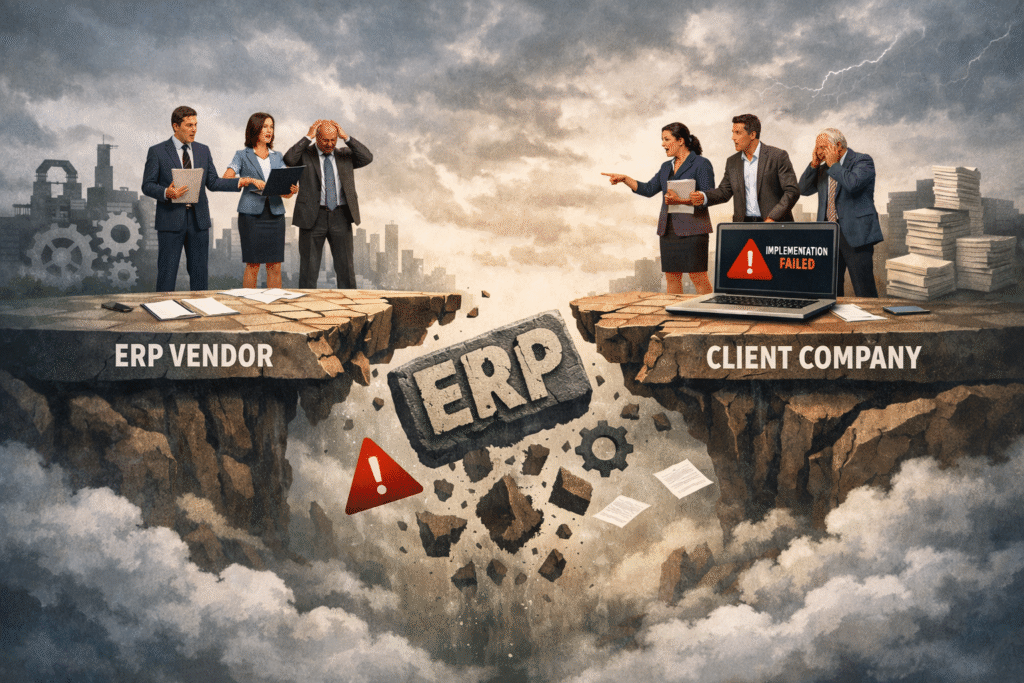
ERP failures are rarely about bad software.
They are about misaligned expectations, weak operating discipline, and execution gaps on both sides of the table.
In the Indian SME ecosystem, ERP is often treated as a medicine for pain.
But ERP is not medicine.
It is an X-ray.
It shows fractures that already exist.
Side 1: The Company Opting for ERP, The Invisible Internal Challenges
Most SME promoters approach ERP with a silent assumption: –
“Once ERP comes, things will automatically improve.”
This belief collapses reality in three places.
1. Process Debt: Years of Informality Packed into One System
Indian SMEs run on people, memory, WhatsApp, and adjustments.
That flexibility works until ERP demands clarity.
- No documented SOPs
- No fixed ownership of data
- No agreed definition of “stock,” “dispatch,” or “production complete”
ERP doesn’t create order.
It hard codes whatever exists.
If chaos exists, chaos becomes permanent and visible.
2. Decision Latency: ERP Forces Decisions You’ve Been Avoiding
Before ERP: –
- Stock mismatches are “adjusted”
- Delays are “managed”
- Errors are “handled personally”
After ERP: –
- Numbers confront you daily
- Variances demand answers
- Accountability becomes unavoidable
Leadership that is used to postponing decisions struggles when the system demands them in real time.
3. Ownership Vacuum: Everyone Uses ERP, No One Owns It
In many SMEs:
- IT thinks ERP is operations’ job
- Operations think it’s accounts’ responsibility
- Accounts think it’s management’s call
ERP becomes a reporting screen not a control system.
ERP doesn’t fail here.
Ownership fails.
Side 2: The ERP Vendor Where Things Quietly Go Wrong
Now comes the uncomfortable truth
ERP vendors are not innocent either especially in custom ERP projects.
1. Selling Before Understanding
Many ERP projects start with:
- Overconfident demos
- Generic industry templates
- “We’ve done this before” assurances
But custom ERP is not replication it is translation.
Translating a live, informal business into a structured system requires deep domain understanding, not just coding skills.
2. Misalignment Between Sales, Product, and Implementation
In too many cases:
- Sales promises flexibility
- Product assumes standardization
- Implementation struggles in between
The client hears “yes”
The system quietly says “no”
And trust erodes.
3. Go-Live Obsession Over Stability
Many vendors optimize for:-
- Faster go-live
- Project closure
- Invoice milestones
Instead of
- Data correctness
- Process adoption
- Team confidence
A rushed go-live in an SME doesn’t mean success.
It means long-term operational fatigue.
4. Underestimating Change Management
ERP vendors often assume: –
“Client will manage people issues internally.”
But SMEs don’t have change managers.
They have supervisors, accountants, and owners doing five roles at once.
When training is shallow and adoption is forced, resistance silently grows.
The Hard Truth No One Likes to Admit
ERP does not create discipline.
It exposes whether discipline already exists.
ERP does not fix:-
- Bad inventory practices
- Poor housekeeping
- Weak leadership habits
- Informal decision culture
If the stockroom is chaotic, ERP will only tell you how chaotic faster.
If management avoids hard conversations, ERP will surface them daily.
What Actually Works (In Indian SME Reality)
Successful ERP implementations happen when:-
- ERP is treated as an operating-model change, not an IT project
- Business owners accept process ownership, not delegation
- ERP vendors invest time in understanding before building
- Go-live is treated as the beginning, not the finish line
- Operational accountability leads the project not IT alone
ERP works when both sides grow up together.
The Final Question That Decides Everything
Are you implementing software or redesigning how your business actually runs?
Which roles will change?
Which meetings will disappear?
Which KPIs will finally matter?
Because ERP will not save a weak operating model.
But for a disciplined business,
ERP becomes the most powerful mirror and multiplier you will ever install.
ERP doesn’t fail because software is weak.
It fails when the operating model is.
If this resonates with your experience, share your story or DM me for an honest conversation.
#ERP #ERPImplementation #CustomERP #ManufacturingFounders #IndianSMEs #ManufacturingIndia #FamilyBusiness #BusinessLeadership #ProcessDebt
#OperationalExcellence #ExecutionMatters #ChangeManagement #FounderMindset #IndiaBusiness #B2BIndia